Voices of Resilience: Exploring Agency in Contemporary Slavic Poetry
The project "Voices of Resilience" examines agency and resilience in contemporary poetry from Ukraine, Belarus, Poland and Bosnia. The project is financed by the Gerda Henkel Foundation.
Voices of Resilience: Exploring Agency in Contemporary Slavic Poetry
The project “Voices of Resilience: Exploring Agency in Contemporary Slavic Poetry”, funded by the Gerda Henkel Foundation, examines the construction of agency in contemporary Slavic poetry, particularly in the context of flight, displacement and war experiences.
Against the backdrop of the Russian invasion in 2022 and the beginning of the war back in 2014, the people of Ukraine have shown an unprecedented degree of agency and subjectivity. The project analyses how lyrical subjects articulate agency in poems and how poetic practices promote resilience under extreme conditions. Particular attention is paid to female or female-connoted poetic figures, as many of those displaced by war and violence are women whose writing, speaking and literary practices have an additional dimension of agency rooted in gender.
In addition, a comparative approach is taken to examine experiences of displacement in poetry from Belarus, Poland and Bosnia in order to gain a nuanced picture of agency and resilience in the context of Slavic literatures.
The project team consists of Slavicists Mariya Donska (project leader, post-doc), Julia Jahn (doctoral candidate) and Anna Gierlinger (student assistant).
8th Doctoral Student Conference on Slavic Studies in Graz
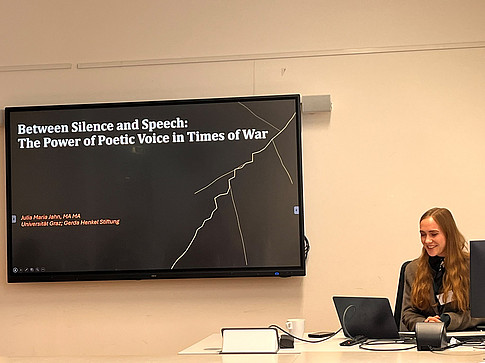
On October 9, 2026, the 8th Doctoral Student Conference on Slavic Studies took place in Graz. As part of this conference, doctoral student Julia Jahn presented excerpts from her dissertation, which she is writing as part of the project.
In her presentation titled “Between Silence and Speech: The Power of Poetic Voice in Times of War”, she used Ukrainian and Bosnian war poetry to illustrate how the role of poetry changes under conditions of violence and trauma: The focus is on metapoetic reflections on one’s own speechlessness, as well as the question of what kind of agency literature can exert in times of war.
15th Slavic Studies Conference 2026 at Friedrich Schiller University Jena
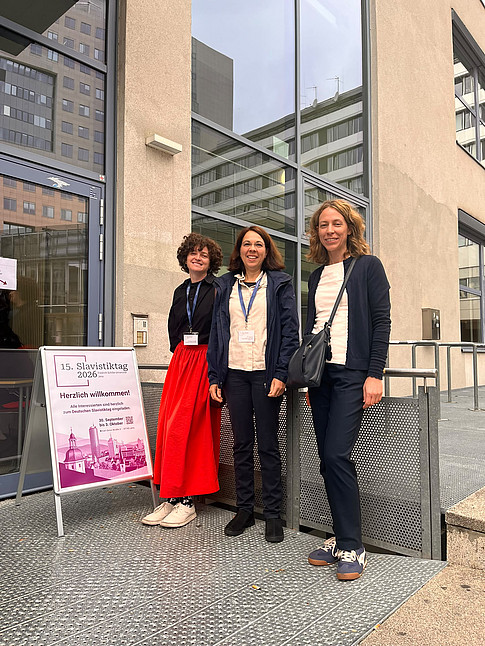
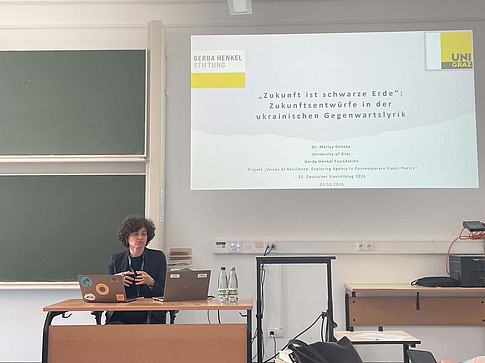
From September 30 to October 3, 2026, the 15th Slavic Studies Conference took place at Friedrich Schiller University in Jena. As part of the conference, Mariya Donska presented a talk developed within the context of the project: “The Future is Black Earth”: Visions of the Future in Contemporary Ukrainian Poetry. She analyzed poems by Viktoriia Amelina, Pavlo Korobchuk, Serhii Zhadan, Jaryna Chornohuz, and Kateryna Kalytko. The talk demonstrated how visions of the future – ukr. Майбутнє – are created in Ukrainian poetry. Drawing on cultural theories of the future and postcolonial approaches, the presentation explored how the power to imagine the future changes in times of war. A central question of the lecture was: How are (ecological) futures imagined during war, particularly in poetry, but also beyond?
The analyzed poems show that the future is depicted as precarious, material, and relational. Although the individual may not live to see the future, it is conceived collectively, including humans and non-human actors such as grass, earth, and fields. The lecture argued that the power to imagine the future resists the “resourcification” of Ukraine (Bazdyrieva) and strengthens the agency of Ukrainian subjects.
First publication within the project has appeared!
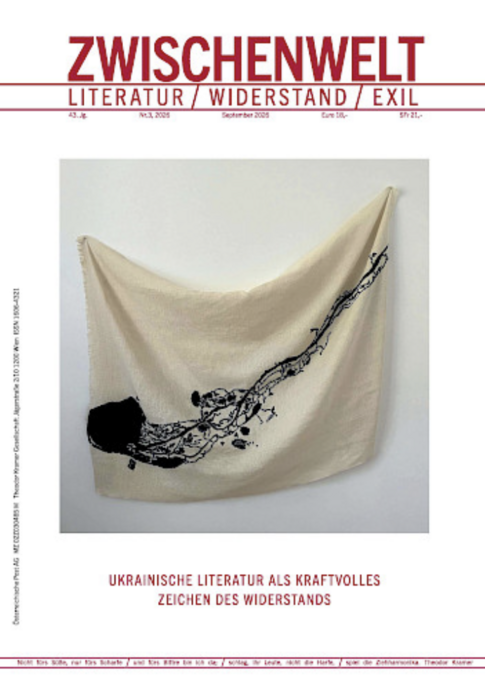
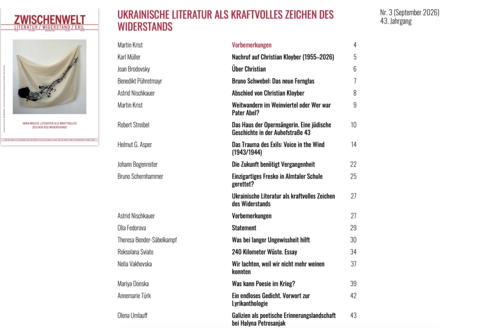
The first scholarly publication resulting from the project has now been published. Entitled “Was kann Poesie im Krieg? Zur Agency in der ukrainischen Gegenwartslyrik” (“What Can Poetry Do in War? On Agency in Contemporary Ukrainian Poetry”), the article explores the forms of agency that Ukrainian poetry can develop in the context of Russia’s war of aggression against Ukraine.
The publication appeared in the Vienna-based journal Zwischenwelt (3/2026) in a special issue “Ukrainische Literatur als kraftvolles Zeichen des Widerstands” ("Ukrainian Literature as a Powerful Sign of Resistance"). The article is available on the website of the journal: https://theodorkramer.at/zwischenwelt/ausgaben/ukrainische-literatur-als-kraftvolles-zeichen-des-widerstands/
We are delighted to be collaborating with Zwischenwelt and are working hard on further articles ;)
RUTA Annual Conference 2026 – Rooted Knowledges and Dialogues for Change
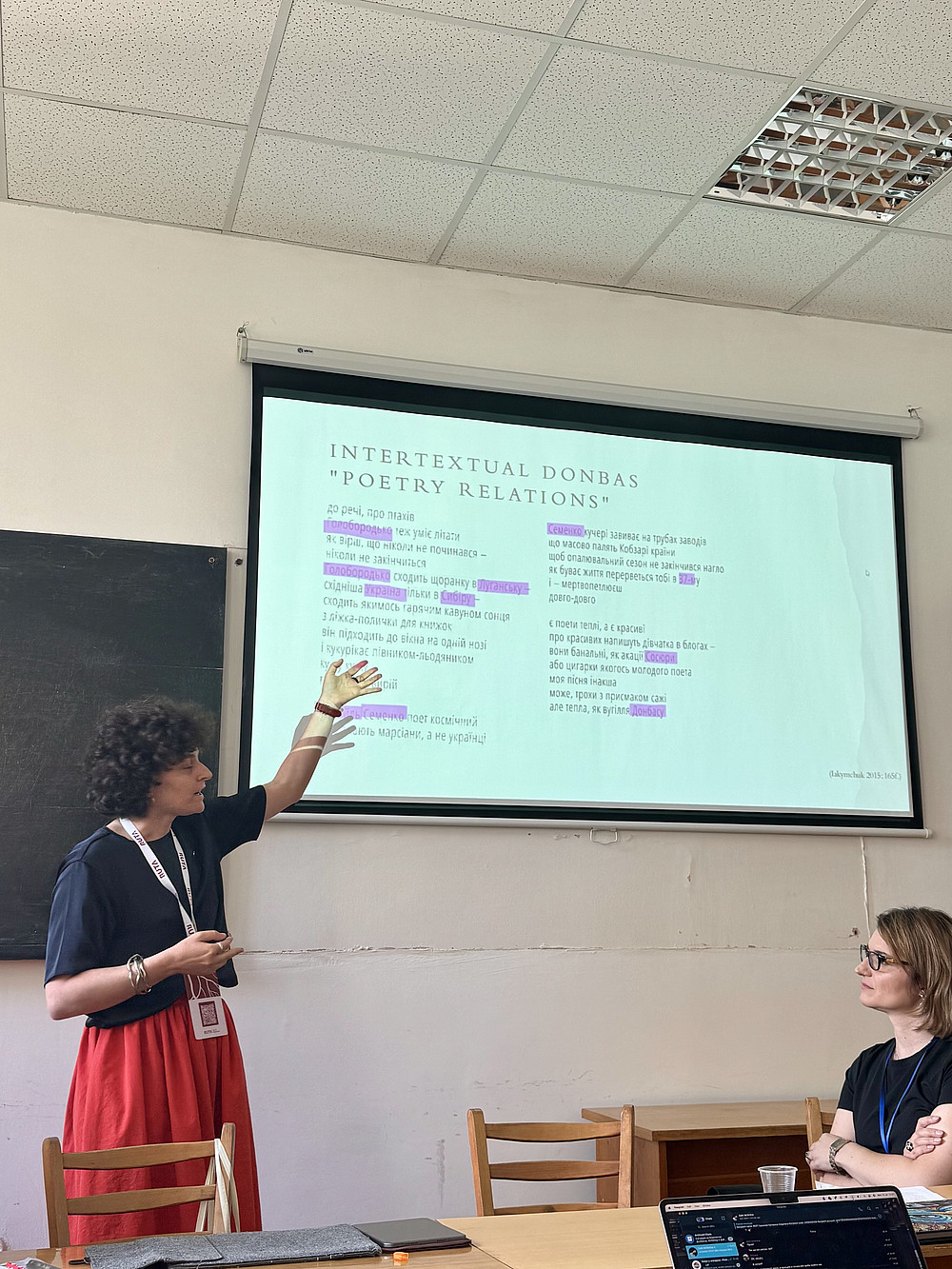
From July 12 to 15, 2026, we attended the RUTA Annual Conference in Uzhhorod, Transcarpathia, under the title “Rooted Knowledges and Dialogues for Change.” The conference brought together scholars, artists, and activists from various disciplines and regions to discuss the importance of place-based knowledge, embodied experience, and transregional dialogue for social change. As part of the conference, Dr. Mariya Donska (University of Graz) presented a lecture titled “Embodied Grass: (Re)Imagined Communities in Liubov Iakymchuk’s Abrykosy Donbasu.” The poetry cycle *Abrykosy Donbasu* (Apricots of the Donbas) by Liubov Iakymchuk, first published in 2015, challenges the common association of the Donbas region with coal and industry and instead paints a picture of the Donbas as a space shaped by nature—in particular, apricot trees, the steppe, terykony (coal spoil heaps), feather grass, and other plants.
The name “Donbas” has economic and industrial connotations and is now coming under criticism, with the term “Eastern Ukraine” or the names of the regions Donetsk Oblast and Luhansk Oblast becoming more widely used. Yakymchuk reimagines the Donbas as an interwoven space in which nature, human bodies, social practices, and technology are closely interconnected. Coal appears as grass compressed over millions of years and—just like the grass itself—is metonymically linked to people’s bodies, their gender roles, and social practices. Through intertextual references to Ukrainian poets such as Volodymyr Sosjura, Vasyl’ Holoborod’ko, and Vasyl’ Stus, the Donbas is anchored as a genuinely Ukrainian cultural space, counteracting a common tendency toward “othering.” The lecture introduced a new concept of “selfing” to illustrate the decolonial redefinition of space and the emerging agency in describing one’s “own” region. Drawing on eco-poetic and postcolonial approaches, the lecture analyzed how Yakymchuk describes nature and social practices to reimagine the Donbas as a space of embodied, interconnected, and Ukrainian identity.
“Ukraine in the World” – International Conference in Lviv
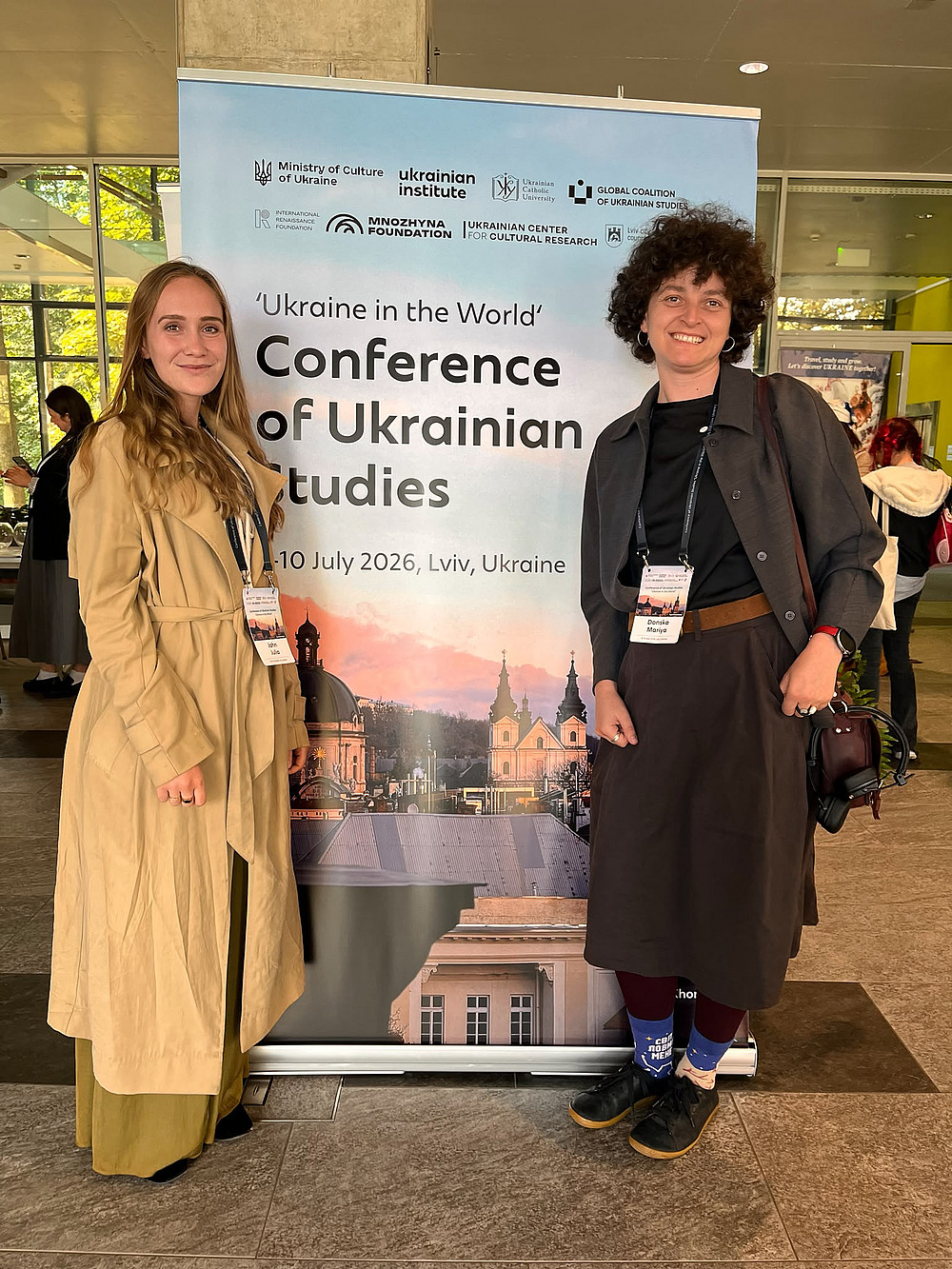
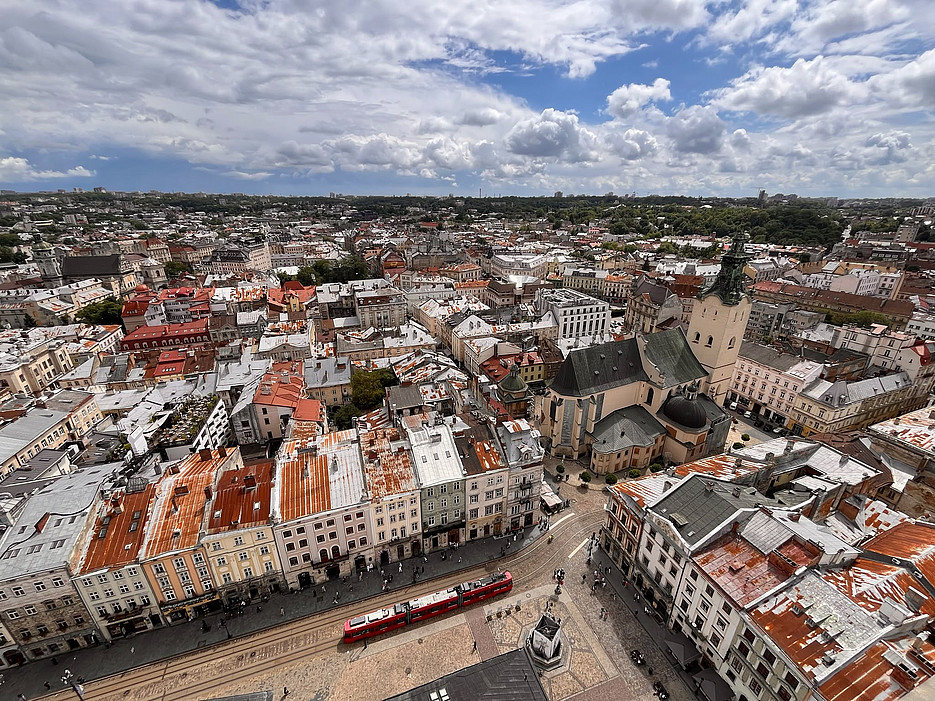
From July 8 to 10, 2026, the international conference “Ukraine in the World” took place in Lviv, bringing together over 250 scholars from 38 countries for an in-depth exchange on the future of Ukrainian Studies.
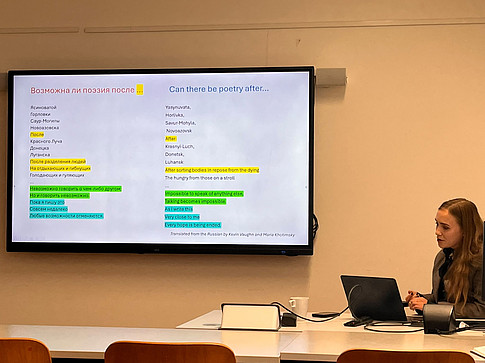
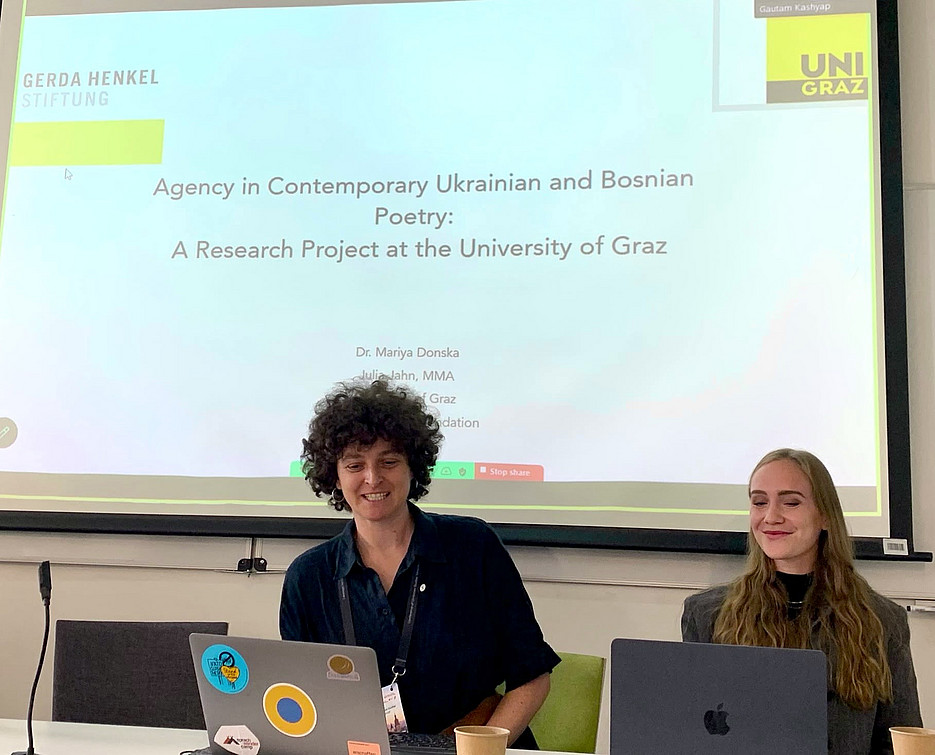
As part of the conference, Mariya Donska (project leader) and Julia Jahn (Ph.D. candidate) jointly presented the research project “Voices of Resilience: Exploring Agency in Contemporary Slavic Poetry.” Through a comparative analysis of two poems, they examined the poetic processing of war experiences and the construction of agency in contemporary Bosnian and Ukrainian poetry.
First, the discussion focused on Bisera Alikadić’s poem “I molitva i kletva” (“Both Prayer and Curse,” 1992), which was written at the outset of the Bosnian War. The poem rejects a purely passive role as a victim and combines prayer and curse, through which the poetic voice articulates both suffering and resistance. The poem’s structure, characterized by imperatives and direct addresses to God, highlights agency: The speaker demands active action and identifies the aggressor using various terms, thereby regaining control over the narrative interpretation through semiotic agency. In the second part of the presentation, a poem by Halyna Kruk, one of the leading Ukrainian poets from L’viv, was analyzed. Here, too, the poem begins with an invocation of God and focuses on the voice (“голос”) as a central motif. Agency is evident both in practical acts of resistance and in the performative power of language. The voice advocates for those particularly affected by the war—the voiceless—and emphasizes a new solidarity among all those affected by the war (“серце б’ється за кожного”—“the heart beats / fights for everyone”). The syntactic structure — a single sentence without full stop at the end — reflects the ongoing unresolved nature and openness of the events. The poem performs agency by giving a voice to the silent community, thereby making visible the semiotic agency of the subalterns.
Empowered Poetry? Project Presentation at the University of Vienna
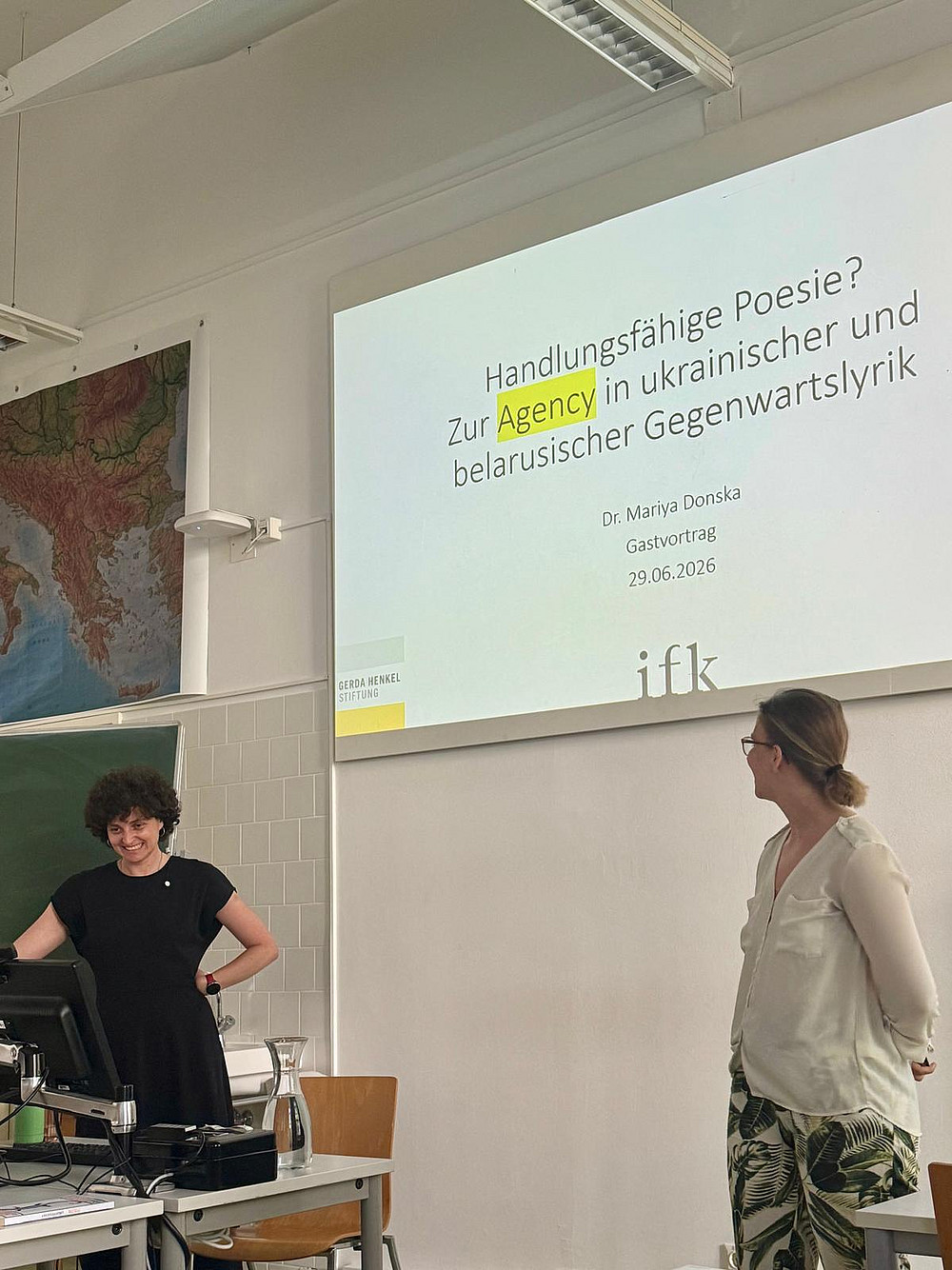
At the invitation of the Department of Slavic Studies in Vienna, Dr. Mariya Donska, principal investigator of Voices of Resilience. Exploring Agency in Contemporary Slavic Poetry, presented initial considerations and findings from the ongoing research project in the lecture hall of the Institute for East European History.
The lecture focused on the question of agency in contemporary Ukrainian and Belarusian poetry. Mariya Donska began by discussing the concept of agency from a theoretical perspective, exploring its applicability within literary studies.
She then presented exemplary analyses of East Slavic contemporary poetry, highlighting agency as a central motif. In the final part of the lecture, she examined, based on qualitative interviews, the actions of readers of poetic texts as well as other actors in the literary field.
The presentation paid particular attention to the genre-specific potential of poetry as a medium for strengthening (postcolonial) agency: How is agency represented in poetry, and to what extent can it be activated through poetry itself?
Poetic Processing of Trauma and Agency: Julia Jahn’s Lecture at PRO SCIENTIA
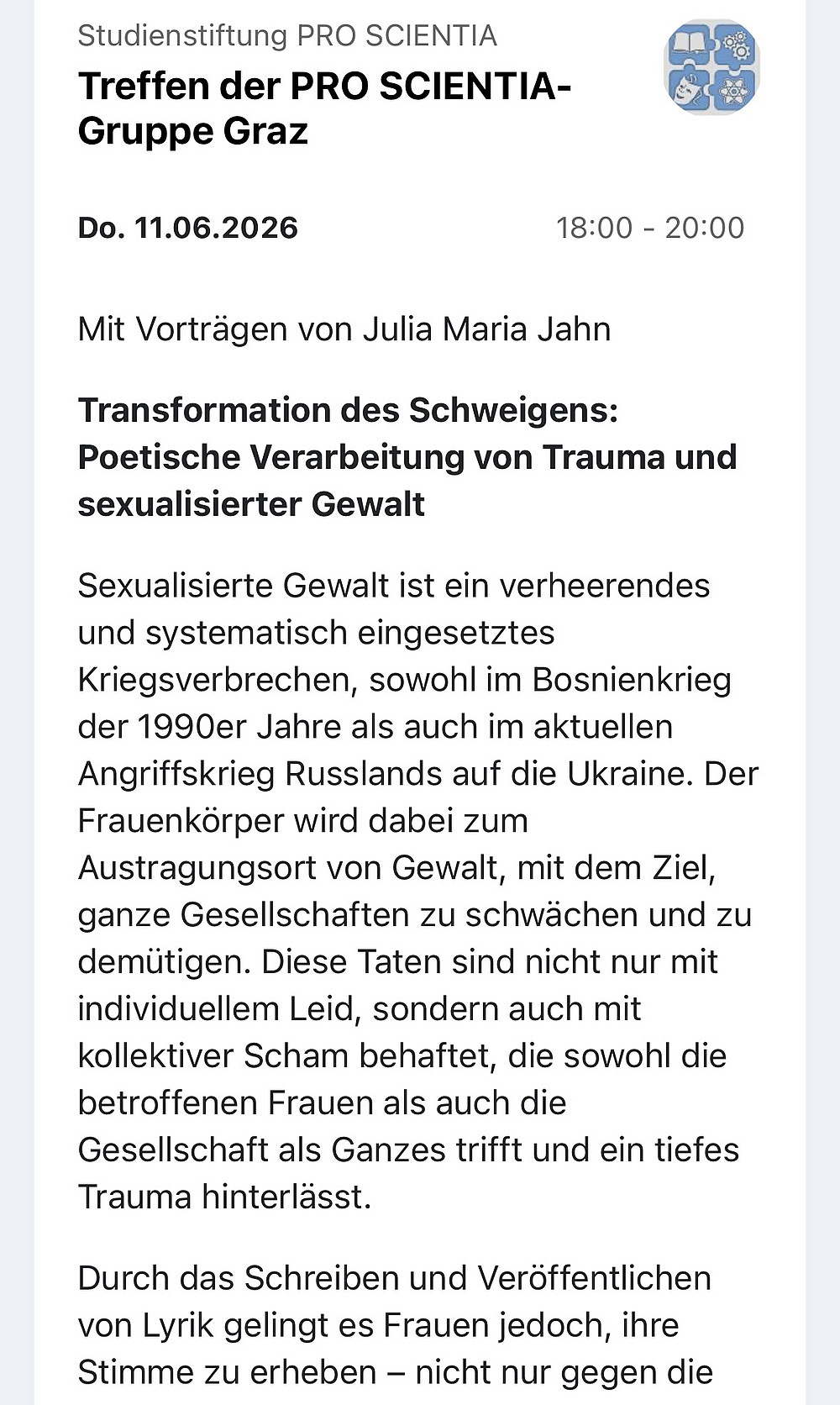
As part of an interdisciplinary session at the PRO SCIENTIA scholarship foundation, Julia Jahn, doctoral candidate and project member, gave a lecture entitled “Transformation of Silence: Poetic Processing of the Trauma of Sexualized Violence in Bosnia and Ukraine.”
In her presentation, Julia Jahn addressed the question of how sexualized violence, used as a systematic weapon of war—both during the Bosnian War of the 1990s and in the current Russian war of aggression against Ukraine—is processed in literature. She demonstrated that, in both conflicts, the female body becomes a site of violence, with the aim of weakening and humiliating entire societies. These acts leave not only individual suffering but also collective shame and deep trauma.
The lecture also focused on how agency—understood here as the ability to act autonomously and raise one’s voice despite traumatic experiences—is constructed in the poetry of women from Bosnia and Ukraine.
The analysis combined approaches from trauma studies (including Cathy Caruth and Judith Herman) with postcolonial theory, placing agency at the center. Particular emphasis was placed on how poetry functions as a medium of resilience and empowerment, opening up new spaces for female agency. The lecture was met with great interest and sparked a lively discussion among the attending fellows from various disciplines.
Agency in Contemporary Ukrainian Poetry: Project Presentation at BASEES 2026
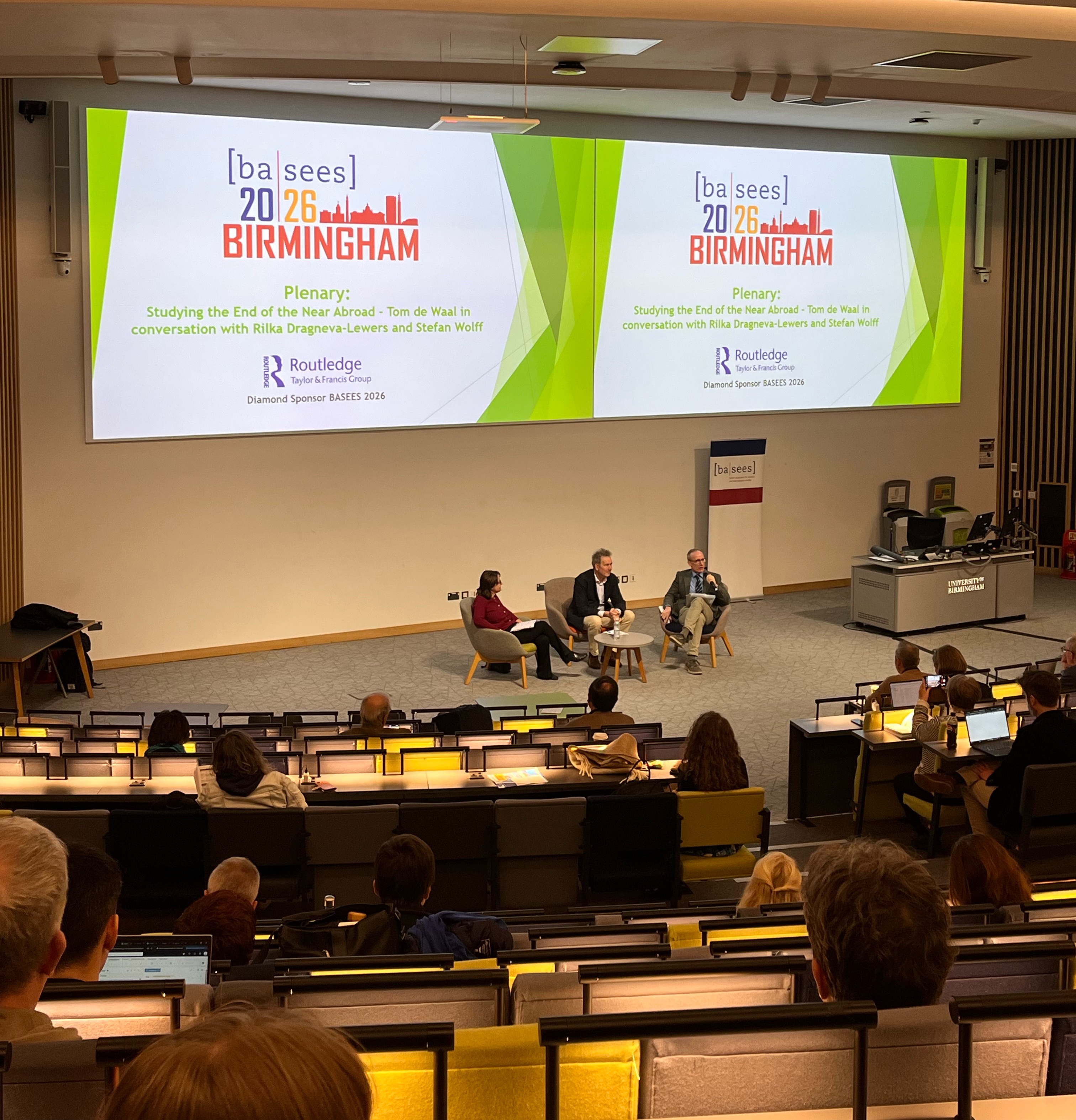
On 12 April 2026, project leader Dr Mariya Donska presented the initial research findings of the “Voices of Resilience” project at the annual conference of the British Association for Slavonic and East European Studies (BASEES) at the University of Birmingham.
In her presentation, Mariya Donska focused on the significance of agency in contemporary Ukrainian poetry and demonstrated how poetry in Ukraine has become a crucial medium of resilience. Using selected works by Mariana Savka, Halyna Kruk, Vasyl Makhno and Viktoriia Amelina, she analysed how poetic texts enact two types of agency – practical and semiotic agency – strengthen the ability to express one’s own feelings and intentions (voice), and make decolonial strategies visible through formal means such as intertextuality or shifts in language.
A vivid example of this was provided by the artist Dina Chmuzh from Kharkiv, who writes poems on plywood panels from destroyed houses, thereby bringing poetry into the public space and into people’s everyday lives. Donska also emphasised the importance of poetic practices in everyday life: in qualitative interviews, respondents described how reciting poetry in crisis situations can provide consolation and foster resilience.
The lecture led to a stimulating discussion with international colleagues.
Solidarity for students, research and teaching: “Voices of Resilience” at the demonstration against budget cuts in Austria
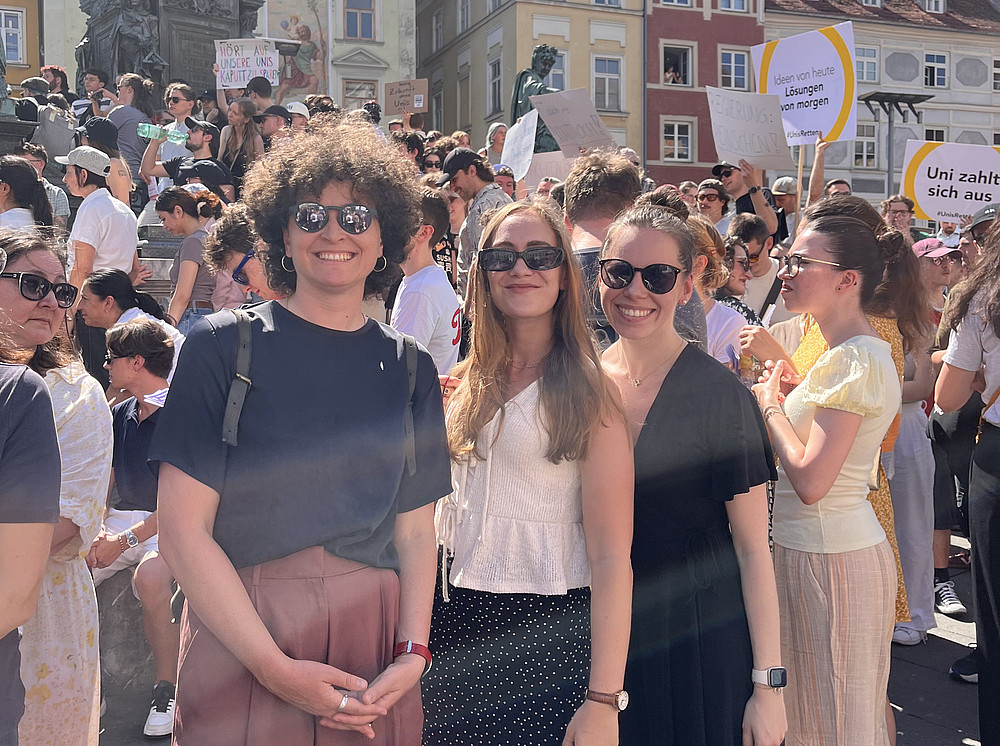
Staff from the “Voices of Resilience” project also took part in the demonstration on 28 May against the planned budget cuts in the Austrian university system. Together with thousands of students and researchers from all Styrian universities, we drew attention to the serious consequences for research, teaching and Styria’s position as a centre of science.
With “Voices of Resilience”, we aim to make a significant contribution highlighting the importance of Slavic literatures in the context of resistance and resilience.